

Skills/Tools for Personal Trainers

Training Happy for Positive Behavioral Change
Are happiness exercises part of your training program design? Does that question seem odd? As you embark on a new year of helping clients work toward their fitness resolutions, this is the perfect time to pause and consider how you can use every tool at your disposal to make sure people succeed. Your toolbox includes harnessing the power of positivity to promote physical activity.

Using Anti-Rotation to Coach Rotation
When you watch someone hit a golf ball, throw a punch or simply retrieve groceries from the car, it’s evident that human movement occurs in all three planes of motion. A review of basic core anatomy—major muscles attached to the trunk, above the ischial tuberosity and below the superior aspect of the sternum—reveals that 87.5% of the core muscles are oriented either diagonally or horizontally, and one action that these muscles perform is rotation (Santana 2000).

Motivational Interviewing: Talking Their Way to Health
Do you want to be a wrestler or a dancer?
This question stands at the center of motivational interviewing (MI), which emerged more than three decades ago to assist people in making difficult changes like overcoming addiction. Health coaches can use MI to help people stop harmful behaviors and start helpful ones. Consider a likely scenario:

How to Improve Tennis Performance
Tennis is one of the most popular sports in the world. In the U.S. alone, there are almost 18 million players, with another 14 million expressing interest (TIA 2018). Unfortunately, the dynamic, forceful twists and turns of the game pose ever-present injury risks to players (Roetert & Kovacs 2011).

Hiring the Nutrition-Fitness Hybrid Pro
What are consumers looking for when they come to your gym or studio? Sure, they want great workouts and access to the latest equipment in a welcoming, fun environment. But above all, they really want to attain their health and fitness goals.

Integrating Cognitive Training Into Exercise Programs for Older Adults
How can you “cognify” exercises to give your clients a big kick in the hippocampus? The basic ideas here can help you integrate cognitive stimuli into most exercises.

Women and Weight Training
Every day, more women are moving from the cardio room to the weight room. It’s a welcome transition; getting stronger can transform their self-esteem, confidence and self-efficacy.

Balance and Stability
Balance, which is essential for integrated movement, declines as we age. However, you can teach group fitness students how to maintain balance while also taking them through some fun, creative core exercises. Having a strong trunk and hip complex helps us maintain balance for years to come. In your next class, incorporate these multiplanar exercises targeting the core musculature and the gluteals. Each move is done in a standing position, and equipment is optional. Encourage attendees who struggle with balance to perform these exercises against a wall or while holding onto a barre.
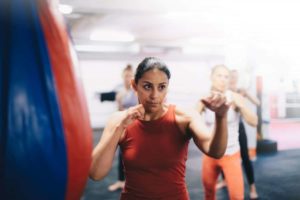
Kickboxing Safety: Back to Basics
Kickboxing classes may not be as popular today as they were in the late 1990s, but people still love to hone their skills with this effective cross-training option. Whether you’ve been teaching for several years or you’re just getting started, it’s always a good idea to review the foundational concepts that make up this total-body workout.

Hot Yoga May Provide Heat Stress Conditioning for Athletes
If you’re looking for a good cross-training technique for your more athletic clients, suggest they practice hot yoga, which may boost aerobic performance while minimizing exercise stress.
University of British Columbia, Vancouver, researchers recruited 10 elite female field hockey players for observation. All athletes participated in 60-minute hot-yoga classes (30 degrees Celsius/86 degrees Fahrenheit) over 6 consecutive days, during which they did not engage in any other exercise. Following the intervention, the athletes played in a national-team camp.

Use Stress to Fuel Peak Performance
You’ve been training for a 10K. You’re ready, but when you show up on race day, your heart is pounding and you feel panicked. What should you do to lower your stress? Some people might say, “Take a deep breath.” We all know that deep breathing to calm the nervous system is a go-to strategy for dealing with stress. But is it always the best strategy?

Cool Down With Reciprocal and Autogenic Inhibition Techniques
As you wind down your dance, step, strength or boot camp class, many attendees are uncoupling from your intentional instruction and preparing for the next stop in their busy days. Don’t let participants leave without a solid cooldown experience! Next time, as you lead the stretch, why not share a little science with them?

A Setup for Successful Subbing
If you teach an ongoing group fitness class, inevitably you’ll need a sub. Odds are also strong that you’ll be a substitute at times throughout your teaching career. Whether you are subbing out or subbing in, you want the experience to be the best one possible—for your class, the other instructor and yourself.

Volume Is Key Factor In Building Strength
The secret to increasing strength and muscle mass may have more to do with how much training you do than how often you do it, according to a new report.

Strength Ladder
Strength training classes don’t have to adhere to a classic “sets and reps” template. Why not climb your way up and down this fun fitness ladder for a fast and furious total-body workout? Repetitions are high, but so is the frequency of change, keeping interest piqued during intense work sets.
Strength Ladder Details
GOAL/EMPHASIS: total-body strength training
TOTAL TIME: 1 hour

Tennis: Reduce Pain, Improve Performance
Tennis is one of the most popular sports in the world. In the U.S. alone, there are almost 18 million players, with another 14 million expressing interest (TIA 2018). Unfortunately, the dynamic, forceful twists and turns of the game pose ever-present injury risks to players (Roetert & Kovacs 2011).
If your fitness clientele includes people interested in playing this sport, you need to understand the causes of tennis-related injuries. This will help you develop strategies to improve movement function, reduce pain and keep clients on the court.

High-Intensity Interval Training for Fat Loss
Two recent studies reveal that high-intensity interval training has the ability to produce high-impact fitness gains in a short time frame.

Sample Class: Mindful Restoration and Recovery
High-intensity interval training has been all the rage for a while now, but participants are finally starting to recognize the benefits of recovery. During this restorative phase, the body repairs itself, which leads to optimal training improvements. The following class supports the recovery process by exploring mindfulness, relaxation and breathing techniques. It also addresses body awareness, muscle tension and myofascial trigger points. Make this a stand-alone 60-minute class or condense it to a 30- or 15-minute session.

Best Foot Forward
A challenging beginning. Ezra didn’t have an easy start. Born with club feet—a congenital condition in which the foot is twisted out of shape or position—he had his first surgery shortly after birth and spent the first few years of life sleeping with corrective boots.

Spotting and Fixing Flaws in Walking Biomechanics
Participating in a program of regular exercise is a good idea at any stage of life, but particularly as we get older. Exercising frequently and consistently has many documented benefits, including promoting good health, preventing disease, enhancing mental health and physical capacity, aiding recovery from injury and illness, minimizing the effects of aging, and improving one’s ability to handle the physical demands of life (Bird, Smith & James 1998).