

What the Updated Food Pyramid Means for Active Adults
Clarifying the Changes
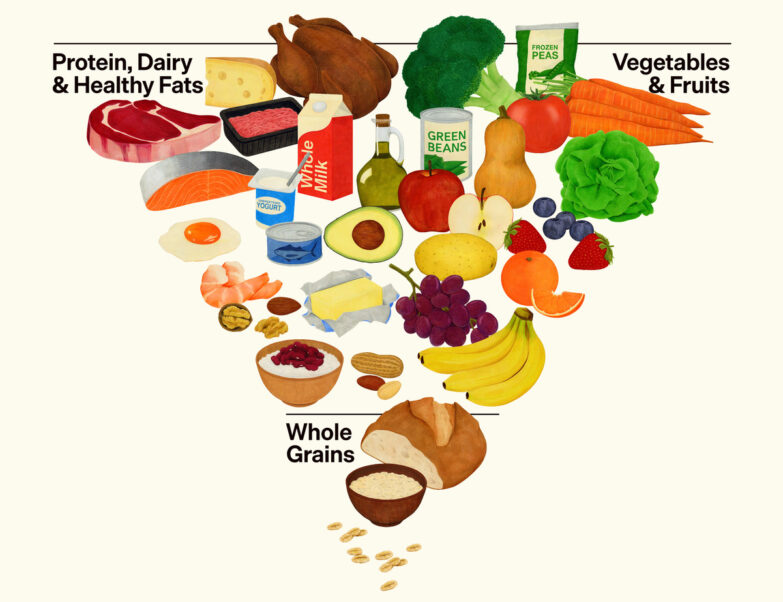

Dietary guidance frameworks commonly referred to as the “food pyramid” have evolved repeatedly over the past several decades. While the original pyramid graphic has been replaced by newer models, the term continues to serve as shorthand for population-level nutrition guidance. Recent updates to these frameworks reflect shifts in how nutrition science, public health priorities, and food systems are interpreted and communicated.
These updates have generated discussion within the nutrition community. Some experts view the changes as a clearer reflection of dietary patterns, while others raise concerns about oversimplification, practical application, or unintended consequences. For fitness professionals, the goal is not to resolve these debates, but to understand what has changed, what has not, and how to discuss these shifts responsibly and within scope.
This article outlines the key updates to dietary guidance frameworks, highlights areas of consistency and contention, and clarifies how fitness professionals can use these tools as references rather than prescriptions.
How Dietary Guidance Has Shifted
Earlier versions of the food pyramid emphasized hierarchical food groups and suggested relative quantities through visual proportion. Over time, this approach was criticized for its lack of clarity, limited personalization, and difficulty translating guidance into real-world eating behaviors. In response, newer frameworks shifted away from strict hierarchy toward representations that emphasize balance across food categories.
Recent updates continue this trend by focusing on dietary patterns over individual nutrients. Rather than prescribing specific servings or ratios, current models emphasize overall balance, variety, and moderation across food groups. This shift reflects growing recognition that long-term health outcomes are influenced by cumulative eating patterns rather than isolated food choices.
While this approach aligns with some interpretations of nutrition research, it has also prompted debate about whether broad pattern-based guidance adequately addresses individual needs, activity levels, or metabolic differences.
Key Changes in the Updated Framework
One of the most visible changes in recent dietary guidance is the reduced emphasis on quantitative targets. Instead of specifying exact amounts of grains, proteins, or fats, updated models encourage flexible composition within food categories. This is intended to accommodate cultural preferences, accessibility, and sustainability considerations.
Another change is increased attention to food quality within categories, such as distinguishing between whole and refined grains or different types of dietary fats. However, critics note that these distinctions may still be interpreted inconsistently by the public, particularly without individualized guidance.
Updated frameworks also place greater emphasis on limiting certain components, such as added sugars and sodium, while avoiding prescriptive calorie targets. Supporters argue this simplifies messaging, while others suggest it may obscure how these recommendations apply to active populations with higher energy needs.
What Has Remained Consistent
Despite revisions, several foundational principles have remained stable across iterations of dietary guidance. Fruits and vegetables continue to be emphasized as core components of eating patterns. Protein-rich foods, whole grains, and dietary fats remain part of balanced models, even as their relative representation shifts.
Hydration, energy balance over time, and dietary variety are consistently acknowledged as important, even when not visually emphasized. These points of continuity help explain why many nutrition professionals view updates as refinements rather than radical departures.
At the same time, consistency does not imply universal agreement. Ongoing research continues to explore optimal dietary composition across different populations, activity levels, and health contexts.
Why There Is Professional Disagreement
Nutrition science is complex, and population-level guidance must balance evidence, feasibility, and public health priorities. Some experts argue that simplified visual models risk obscuring important nuances, particularly for physically active adults whose energy and macronutrient needs may differ from population averages.
Others raise concerns about how dietary guidance intersects with food systems, sustainability goals, and economic factors, questioning whether these considerations dilute health-specific messaging. Still others argue that any single framework is inherently limited and should be treated as a starting point rather than a solution.
This diversity of perspectives underscores why dietary guidance should be interpreted cautiously and why individualization remains central to effective nutrition support.
Interpreting the Guidance for Active Adults
For active adults, dietary needs are shaped by training volume, recovery demands, body composition goals, and lifestyle constraints. Population-level dietary frameworks are not designed to account for these variables in detail.
Fitness professionals can acknowledge this limitation by framing updated guidance as contextual reference material, not as a template for individual nutrition planning. Discussions can focus on patterns, food variety, and general balance without translating the framework into specific macronutrient targets or meal plans.
This approach helps avoid misapplication of broad guidance to individual situations and reinforces the importance of professional collaboration.
Scope, Referral, and Professional Responsibility
Fitness professionals do not assess nutritional adequacy, prescribe diets, or interpret dietary guidance for therapeutic purposes. When clients seek individualized nutrition advice, express confusion about dietary changes, or present with specific health or performance concerns, referral is appropriate.
Registered dietitians and licensed nutrition professionals are trained to interpret evolving dietary guidance in the context of individual needs, medical history, and performance goals. Fitness professionals support this process by reinforcing the value of individualized care rather than positioning generalized guidance as definitive.
Clear boundaries protect clients and maintain professional credibility.
Implications for Fitness Practice
Updated dietary frameworks offer insight into how public health nutrition is currently framed, but they do not resolve ongoing scientific debate. For fitness professionals, the most responsible approach is neither endorsement nor dismissal, but informed neutrality.
By understanding what has changed, acknowledging where disagreement exists, and reinforcing individualization and referral, fitness professionals can support clients without oversimplifying complex nutrition issues. In this role, dietary guidance becomes a conversation starter rather than a conclusion.