

Cardio/Aerobic

Four Heart Disease Facts
Developing a thorough understanding of coronary artery disease (CAD) can help fitness professionals fight one of the world’s deadliest diseases. ?
How deadly? For starters, CAD is the leading cause of death around the world, accounting for 13.2% of all deaths in 2012 (WHO 2014a). It kills almost 380,000 Americans every year (CDC 2014a). Exercise professionals can do something about these statistics by designing fitness programs that reduce CAD risk factors in clients while improving their quality of life. ?
How to Teach HIIT to Everyone
High-intensity interval training has been riding a wave of popularity, and it seems everyone wants to give it a try. However, intense interval training is nothing new. Group fitness instructors have been teaching HIIT for a long time. Fartlek training, for example, was big in the 1970s. The 1980s brought us high-impact classes, and the 1990s introduced indoor cycling (think repeat hill training). HIIT is a fantastic workout and an effective way to train energy systems; build muscle; lose weight; enhance strength, power and agility; and prevent adaptation.

Reciprocal Superset Training Burns More Calories
Kelleher, A.R., et al. 2010. The metabolic costs of reciprocal supersets vs. traditional resistance exercise in young recreationally active adults. The Journal of Strength and Conditioning Research, 24 (4), 1043–51.

Kettlebells and Cardiovascular Improvements
Despite being around for quite some time—the International Union of Kettlebell Lifting suggests their origin can be traced to Ancient Greece—kettlebells have become a popular “trend.” But is all the fuss surrounding kettlebell training sound?

Concurrent Training Can Jeopardize Strength Gains
A lot of people do concurrent training— cardio and strength training within the same session—because it seems to achieve multiple goals at the same time. It’s also a proven fat-burner, making it a popular choice for general fitness.

Coronary Artery Disease: What Every Fitness Professional Needs to Know
Developing a thorough understanding of coronary artery disease (CAD) can help fitness professionals fight one of the world’s deadliest diseases. ?
How deadly? For starters, CAD is the leading cause of death around the world, accounting for 13.2% of all deaths in 2012 (WHO 2014a). It kills almost 380,000 Americans every year (CDC 2014a). Exercise professionals can do something about these statistics by designing fitness programs that reduce CAD risk factors in clients while improving their quality of life. ?

Research Sheds New Light on the Exercise “Afterburn”
Some of us call it “afterburn”—the elevated calorie burning that lasts long after exercise is over. The scientific literature defines it as excess postexercise oxygen consumption, or EPOC (see Figure 1). ?
For the most part, EPOC represents the body restoring itself from physiological variables elevated by exercise. EPOC is an important physiological phenomenon for fitness professionals because it can play a contributing role in weight management. ?
How to Make HIIT a Hit for Everyone
High-intensity interval training has been riding a wave of popularity, and it seems everyone wants to give it a try. However, intense interval training is nothing new. Group fitness instructors have been teaching HIIT for a long time. Fartlek training, for example, was big in the 1970s. The 1980s brought us high-impact classes, and the 1990s introduced indoor cycling (think repeat hill training). HIIT is a fantastic workout and an effective way to train energy systems; build muscle; lose weight; enhance strength, power and agility; and prevent adaptation.

OTS Indicator Checklist
OTS Indicator Checklist
Personal trainers are encouraged to use this OTS Indicator Checklist to help identify or prevent OTS in clients. Although this list was developed from scientific research, there currently is no research consensus on how many of these factors must be present (and to what degree) to confirm OTS.
PERFORMANCE AND FATIGUE INDICATORS
These may be symptoms of OTS:

Sample Class: Creative Core & Cardio
Group fitness participants can’t seem to get enough of creative core and cardiovascular exercises. If you need innovative ideas to challenge your students, this class is for you! Target core muscles while introducing unique variations of familiar moves. Round out the routine by torching calories with high-intensity interval training exercises.
Creative Cardio and Core Details
GOAL/EMPHASIS: core strengthening and HIIT
TIME: approximately 60 minutes

Heart Rate Variability & Overtraining
Can New Research Prevent an Age-Old Paradigm?
Heart rate variability (HRV) is a reliable marker of physiological factors that directly affect the rhythms of the heart (Acharya et al. 2006). Acharya and colleagues explain that HRV reflects the heart’s ability to adapt to changing circumstances—stress, exercise and disease—by balancing the regulation of the autonomic nervous system, which controls bodily functions such as breathing, heart- beat and digestion.
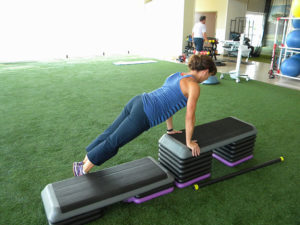
Sample Class: Double Step Conditioning
Double Step Conditioning is a total-body workout that uses two steps set up at different heights for a fresh approach to old moves and an opportunity to infuse new energy into conditioning classes. The workout includes moderate-to-hard cardio bursts to keep people moving and heart rates elevated without pushing into anaerobic zones. Participants will appreciate the seamless flow, sweat and variations.
Double Step Details

How to Make the Most of Express Classes
Time is a precious commodity, and everyone is looking for the fastest, most effective way to exercise. Between jobs, family, daily errands and the occasional social gathering, people work hard to squeeze group fitness classes into their busy lives. That’s why express classes— high-calorie-burning, energy-packed, condensed workouts—are all the rage.

Physical Activity Type in Midlife Affects Mobility in Seniors
Studies have shown that seated desk work can have negative health and mobility repercussions as we age. A new study suggests that physically demanding jobs can also impact function later in life.
The study included 5,200 public sector employees participating in the Finnish Longitudinal Study on Municipal Employees. The primary purpose of the study was to understand the impact of leisure-time physical activity (LPA) and occupational physical activity (OPA) on mobility limitations among older adults.
Is It Best to Lift Weights Before or After Cardio?
There’s a long-standing debate about whether order matters when combining cardiovascular exercise and strength training in a single session. Is it best, for example, to hit the treadmill before or after heading to the weight room? Researchers from the University of Jyväskylä, in Finland, believe they have the answer.

Anaerobic Metabolic Conditioning
Many personal trainers design anaerobic workouts for their clients—it is an innovative strategy that helps many people reach their goals. Competitive athletes have been training anaerobically for years. Bu these types of programs also offer recreational exercise enthusiasts challenge, variety and unique physiological adaptations. Common elements of an anaerobic workout include intervals, sprints, repeated sprints and multiple-sequence exercise combinations performed at higher intensities with shorter duration (Bishop, Girard & Mendez- Villanueva 2011).

Aerobic Exercise and Strength Training for Older Women: Is There an Optimal Starting Dose?
We have good exercise guidance for fit older adults, but the advice for seniors just starting a fitness program has been less clear.
Sample Class: Cardio Step
Step used to be one of the most popular group cardio formats. Although it has recently seen a slight decrease in popularity—mostly because new programs have proliferated and time slots are limited—step still has its place. Delivering step classes requires creativity, strong teaching skills and preparedness. The following routine includes a full breakdown with a choreography progression.
Kick It Into High Gear
A martial-arts–inspired warm-up increases circulation, improves dynamic flexibility and range of motion, integrates sport-specific activities and connects body and mind. The series presented here is an excellent way to begin almost any general fitness class. Start slowly and encourage students to be patient and “listen” to their bodies.
Awaken the Center
First, bring attention to the back and abdominals, the body’s “center.”

Resistance Training or Aerobic Training: Which Is Best for Weight/Fat Loss?
That’s precisely the question that researchers from North Carolina wanted to investigate.