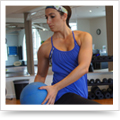
Core Strength: Standing Exercises
Why do we usually train the core from the floor? Most people don’t spend the majority of their days on the floor, nor is it common to get injured from lying down or watching television. Injuries typically happen from improper technique, lack of body awareness and limited movement. Standing upright for core training allows you to move your body in all planes of motion and enhances core and spinal stabilization and balance.
It’s time to take a stand. Get participants on their feet and out of the computer-typing, freeway-driving position they find themselves in way too often. Encourage weight-bearing, multijoint movements that require more work and recruit more muscles, both of which may aid in fat loss—a goal that’s at the forefront of many participants’ minds.
The following four multijoint, multiplanar moves provide a full-body workout while emphasizing core musculature. Modify these exercises to fit your audience. Have participants perform the moves two to three times each for about 30 seconds to 1 minute, or until fatigued.
The Lawnmower
Equipment: resistance bandPreparation: Place right (R) foot in middle of resistance band (one handle will be on ground). Hold handle in left (L) hand and stand upright, feet shoulder-width apart.
Execution: Lower body into squat, rotate torso to R knee and internally rotate L knee and ball of foot. As you stand, pull band up and across chest (as if starting a lawnmower) to L shoulder, and extend band so arm is straight above your head, creating diagonal line of energy from foot to tip of hand. Bring hand back to shoulder height and repeat. Switch sides.
Regression: Move into shallow squat.
Progression: Lessen slack in resistance band.
The Rocky
Equipment: dumbbells
Preparation: With dumbbells in hand, thumbs facing up, lower into squat.
Execution: Lift dumbbells to shoulder height; pull navel toward spine. Once at shoulder height, pull dumbbells to rib cage, elbows pointing back. Stay in squat, and punch both dumbbells forward; pause with arms straight in front (hold 1–3 seconds). Lower dumbbells to starting position.
Regression: Punch in standing position.
Progression: Use heavier weight and/or punch twice before lowering dumbbells.
For more exercises, please see “Take a Stand” in the online IDEA Library or in the November–December 2011 issue of IDEA Fitness Journal.

© 2012 by IDEA Health & Fitness Inc. All rights reserved. Reproduction without permission is strictly prohibited.


Delicious
Digg
StumbleUpon
Reddit
Magnoliacom
Newsvine
Facebook
Google
Yahoo
Technorati


Article Comments
On Jan 19, 2012
On Jan 19, 2012
Here is more on my take if you interested: "Core Connection" - http://bit.ly/zdYi2j
@Nick - how are you bud?
Justin Robinson, MA,RD,CSSD,CSCS,FAFS
On Jan 20, 2012
On Jan 22, 2012
I'm not sure what you're referring to in your first line; however, I have never trained the core from the floor.
Maybe they do this in the big McGyms.
In our movement studio, every class or private that we teach, the client is standing, kneeling, moving about on foot, not on the floor. That doesn't sense.
So, it doesn't make sense to me that you are 'opening eyes' to this.
One of the best ways to train the core is to integrate it with the whole system. Functionally, you'll train the body's response to the movement that has you moving all different ways. If you don't move, in other words you do a static exercise, you are limiting the effect of that movement.
Life is not static. Life is not isolated. And, as you pointed out Nicole we don't spend a large quantity of our life on the floor.
I'd add to your solution...rather than 'standing upright' for core training, consider moving upright.
Even though this is not weight based, it absolutely is core training..here's an example.
http://www.youtube.com/watch?v=okGUlLItU44&hd=1
On Jan 22, 2012
On Jan 25, 2012
May I say one thing:
The core ain't the abdominals. It's 29 muscles.
If you are a fitness professional and you don't know this....anyway.
Since the dawn of time-you mean cavemen?
On Jan 30, 2012
The Anonymous person must have replied while reading the article from the email link.
I clicked on the link in my email, read the article, started to comment and saw that it said "anonymous" - So I went and logged into my accoutn so my name would be posted :)
Great article, Nicole....this is good to incoporate into workouts/classes. There should be movement in all planes but I also agree with Anonymous that the floor can still be used. Pilates Mat Science is taught from the floor and is very effective.
Again, it's about variety when working the body and it's good to vary the workouts.
I would like to think that we are all professionals on here and would address one another with respect.
On Jan 30, 2012
On Feb 24, 2012
Add Comment