


Pete Holman, MSPT
Pete Holman, MSPT, is a physical therapist, certified strength & conditioning specialist and US National taekwondo champion and team captain. His passion for health and fitness has stimulated a successful adjunct career as an inventor. He produced several products, most notably the TRX® Rip Trainer and the Nautilus Glute Drive. Specializing in biomechanics, core performance and the aging athlete, Pete uses his experience as an elite level athlete and his unique knowledge of the human body, to bring out the athlete in us all. Pete is an active contributor to PTontheNet, IDEA Fitness Journal, STACK Magazine and IronMan Magazine.
Article Archive

Review the anatomy and function of the glenohumeral and scapulothoracic joints and learn basic, low-risk exercises that are designed to improve rotator cuff strength, shoulder mobility and scapulohumeral rhythm.

When you watch someone hit a golf ball, throw a punch or simply retrieve groceries from the car, it’s evident that human movement occurs in all three planes of motion. Did you know that 87.5% of our core muscles are oriented either diagonally or horizontally? One action that these muscles perform is rotation (Santana 2000). The diagonal muscle orientation is proof positive that the human body is designed to rotate.

When you watch someone hit a golf ball, throw a punch or simply retrieve groceries from the car, it’s evident that human movement occurs in all three planes of motion. A review of basic core anatomy—major muscles attached to the trunk, above the ischial tuberosity and below the superior aspect of the sternum—reveals that 87.5% of the core muscles are oriented either diagonally or horizontally, and one action that these muscles perform is rotation (Santana 2000).
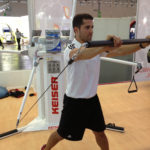
Asymmetrical bar training (ABT) can help clients enhance their sense of balance while improving their core strength and rotational power.
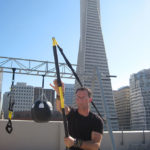
Asymmetrical bar training (ABT) can help clients enhance their sense of balance while improving their core strength and rotational power.